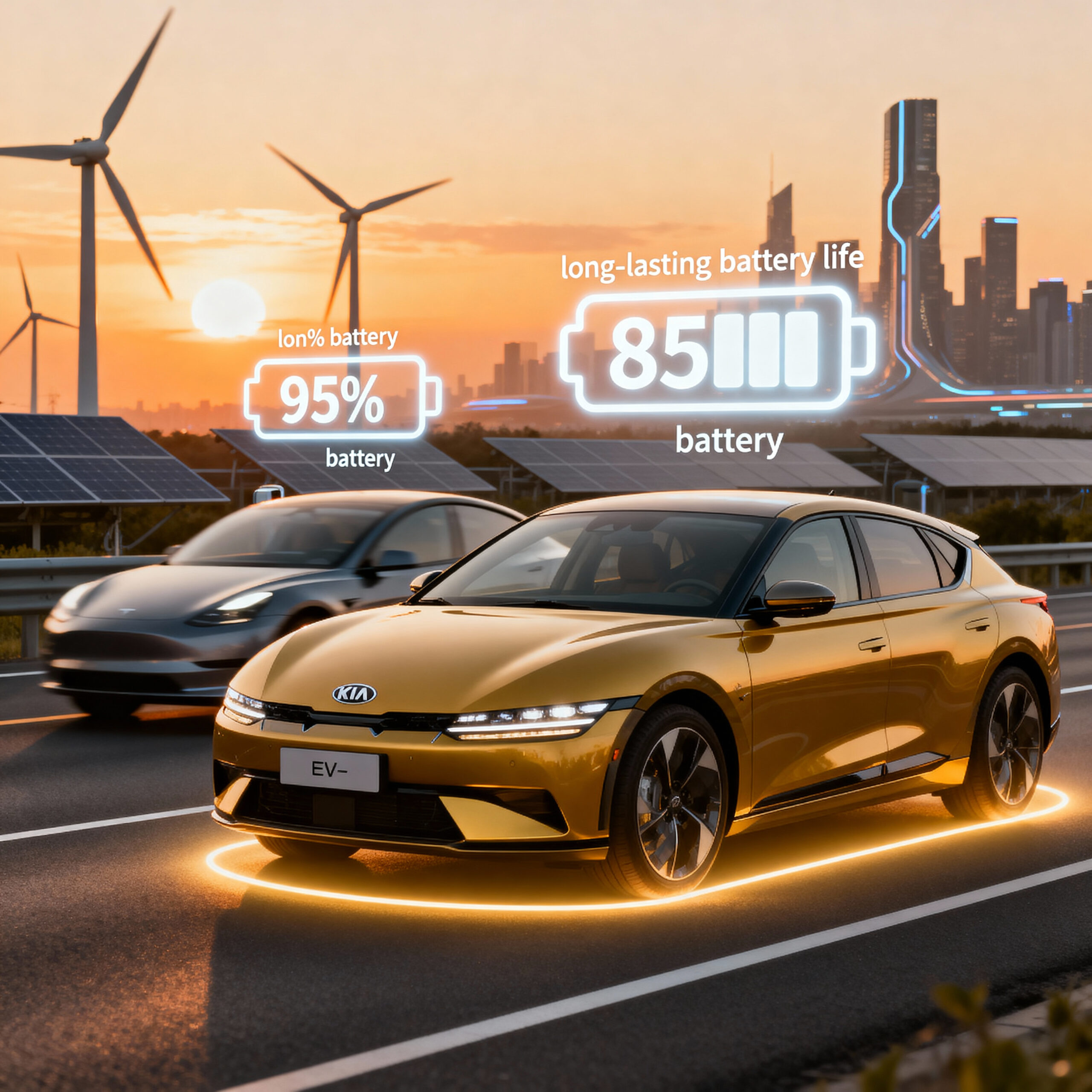
For years, Tesla has been hailed as the undisputed leader of the electric vehicle (EV) revolution — pioneering innovation, speed, and smart design. But a new wave of data is rewriting that story.
Surprisingly, the EV brand with the slowest battery degradation isn’t Tesla at all — it’s Kia.
According to a detailed study by Kvdbil, a Swedish used-car platform that examined more than 1,300 electric and hybrid vehicles, Kia’s EV6 came out on top for battery health retention. The results were so impressive that they sent a ripple through the entire EV industry — showing that Tesla’s dominance in every metric may be ending.
This discovery isn’t just about numbers; it’s about trust, dependability, and the growing realization that the EV world has more than one hero. Let’s dive deeper into what makes Kia’s batteries last longer, how Tesla compares, and what this means for the future of electric driving.
⚡ Understanding Battery Degradation — and Why It Matters
Every battery, whether in your smartphone, laptop, or car, slowly loses its ability to hold charge over time. This natural process, called battery degradation, affects how far your EV can travel on a single charge.
If your EV originally offered 300 miles per charge, after a few years, that range might drop to 270 or 280 miles. This is completely normal — but how quickly it happens depends on several factors, including battery design, charging habits, and temperature management.
That’s why the Kvdbil study is so groundbreaking. It shows that Kia’s EV6 battery degrades at a much slower rate compared to others in the same class — even slower than Tesla’s.
🌍 The Study That Surprised Everyone
Kvdbil’s analysis of over 1,300 EVs and plug-in hybrids revealed some eye-opening facts:
- Kia EV6 ranked #1 for maintaining the best State of Health (SoH) — a measure of how much energy the battery retains compared to when it was new.
- 8 out of 10 EVs in the study still kept 90% or more of their original battery capacity.
- Kia and its sister brand Hyundai both performed exceptionally well.
This means Kia EV6 owners are seeing very little range loss, even after years of use — a huge reassurance for anyone thinking of buying an EV.
🔬 What Makes Kia’s Battery Last So Long?
Kia’s remarkable performance didn’t happen by chance. It’s the result of smart engineering, superior battery management, and next-gen thermal technology.
Let’s break down the secret ingredients behind Kia’s success:
1. Exceptional Thermal Management System
Battery life shortens when it’s exposed to extreme heat or cold. Kia’s EV6 is equipped with a highly advanced liquid-cooling thermal management system that keeps the battery at its ideal temperature no matter the weather.
This ensures the battery doesn’t overheat during fast charging or freeze in winter — both common issues that accelerate wear in other EVs.
2. E-GMP Platform Architecture
The EV6 is built on Kia’s Electric-Global Modular Platform (E-GMP), a cutting-edge design also used in Hyundai’s Ioniq lineup. This platform optimizes space, balance, and cooling, giving every cell uniform protection and longer life.
3. Smarter Charging Algorithms
The EV6’s software controls how quickly and efficiently the battery charges. During DC fast charging, the car automatically adjusts input levels to prevent overheating or stress on cells. This intelligent system is a big reason Kia batteries stay healthy longer.
4. High-Quality Battery Chemistry
Kia uses lithium-ion polymer cells supplied by LG Energy Solution. These are known for balancing power and durability. Instead of chasing maximum energy density like Tesla, Kia prioritized stability — and it’s paying off.
5. Efficient Regenerative Braking
The EV6’s regenerative braking system captures energy every time you slow down, reducing strain on the battery and increasing efficiency. Over time, this contributes to a slower rate of degradation.
🚀 Tesla Still Performs Exceptionally — But Kia Takes the Lead
Let’s be fair — Tesla still produces some of the longest-lasting EV batteries in the world. Data shows that Tesla vehicles lose around 10–15% of capacity after 200,000 miles — an incredible number by industry standards.
However, Kia’s EV6 seems to perform slightly better in real-world tests, especially under mixed driving conditions and varying climates.
Tesla primarily uses NCA (Nickel-Cobalt-Aluminum) and LFP (Lithium Iron Phosphate) cells. While NCA batteries offer higher performance, they tend to degrade faster with frequent supercharging or in high-heat environments.
Kia’s EV6, on the other hand, relies on a more balanced system that focuses on maintaining long-term health rather than extreme power output. The difference may only be a few percentage points, but over years, it adds up.
🌡️ Real-World Factors That Influence Battery Degradation
Even with advanced engineering, every EV’s battery health depends on how it’s used and maintained. Here are some real-life factors that determine how fast (or slow) your battery degrades:
- Charging Frequency: Constantly using fast chargers can heat up the battery and reduce its lifespan. Using regular home charging for daily use is much gentler.
- Charge Range: Keeping your EV between 20% and 80% charge helps minimize wear. Avoid fully draining or topping up your battery frequently.
- Temperature Extremes: Batteries don’t like being too hot or too cold. Kia’s superior thermal system helps offset this better than most.
- Driving Behavior: Hard acceleration and braking generate more heat. Gentle driving keeps the battery cooler and healthier.
- Software Updates: Kia and Tesla regularly release updates that improve battery efficiency and management — another reason their degradation rates remain low.
💰 Why This News Matters to Everyday EV Drivers
Battery health isn’t just a technical detail — it has real financial and emotional value.
- Long-Term Savings: Batteries are the most expensive EV component. A long-lasting battery means fewer replacements and lower maintenance costs.
- Better Resale Value: A car with excellent battery health will command a higher resale price years later.
- Peace of Mind: Knowing your EV can retain 90% of its power even after many years gives confidence and removes range anxiety.
This make kia technologically enhancing.
🌱 The Truth: Battery Degradation Isn’t as Scary as People Think
Lets find how,
For years, potential EV buyers have worried that their batteries would degrade quickly — but studies prove otherwise.
The Kvdbil research shows that most EVs still retain more than 90% of their capacity after several years. That means a vehicle once rated for 300 miles might still deliver 270 miles of range after 5–6 years — hardly noticeable for daily driving.
With new innovations like better cooling systems, software optimization, and advanced materials, modern EV batteries are built to last 15–20 years or more.
So if you’ve been hesitant to switch to an EV, you can rest easy — battery degradation is far less of a problem than people assume.
🔮 The Future of EV Batteries Looks Brighter Than Ever
The next generation of electric cars will take battery durability to an entirely new level. Automakers, including Kia and Tesla, are already working on technologies that promise revolutionary improvements:
- Solid-State Batteries: These upcoming batteries will deliver faster charging, higher safety, and even slower degradation.
- AI-Powered Battery Management: Artificial intelligence will predict and prevent wear by constantly adjusting voltage and temperature in real time.
- Recycling and Second Life Uses: Old EV batteries will be repurposed for home energy storage, giving them new life even after leaving the car.
These innovations mean the EVs of tomorrow won’t just drive cleaner — they’ll last longer and perform better than ever.
🚗 Kia’s EV6: The Hidden Star of Durability
The Kia EV6 has emerged as one of the most complete EVs in today’s market — blending elegant design, lightning-fast 800V charging, and world-class efficiency. But now, its long-term reliability gives it an extra edge over the competition.
Owners often describe the EV6 as effortless — it’s not just about the smooth acceleration or futuristic cabin, but the confidence that comes from knowing your battery won’t fade quickly.
While Tesla captures headlines with innovation, Kia wins hearts with dependability. It’s the quiet achiever that proves endurance can sometimes outshine glamour.
⚙️ Kia vs Tesla: Battery Durability at a Glance
| Feature | Kia EV6 | Tesla Model 3 / Y |
|---|---|---|
| Battery Retention (After Years) | 90–95% capacity | 85–90% capacity |
| Thermal Control | Advanced liquid cooling | Excellent liquid cooling |
| Charging Speed (10–80%) | ~18 minutes (800V) | ~25 minutes |
| Battery Type | Lithium-ion polymer (LG) | NCA or LFP (Panasonic/CATL) |
| Degradation per 100k miles | ~5% | ~7–10% |
Both brands perform exceptionally well, but Kia’s small edge in long-term health makes it the quiet winner in the endurance race.
❤️ Beyond Technology: A Human Story of Trust
This isn’t just about batteries and science — it’s about how we, as people, connect to the machines we drive.
Kia’s achievement shows that sustainability and reliability can go hand in hand. It gives drivers peace of mind, knowing their vehicle isn’t just efficient but also built to last.
In a market often dominated by hype, Kia’s quiet consistency feels refreshing. It proves that you don’t need to be loud to be revolutionary — sometimes, you just need to build something that lasts.
🌟 Final Thoughts
After analyzing thousands of vehicles and real-world data, one truth stands out: Kia’s EV6 currently leads the EV world in slowest battery degradation.
Through superior engineering, thermal control, and battery design, Kia has achieved something remarkable — an EV that not only performs well but also stays strong over time.
Tesla remains a technological giant and continues to innovate rapidly, but Kia’s rise signals a more balanced, competitive, and sustainable future for the EV market.
So the next time you think of long-lasting electric power, remember: the quiet champion isn’t always the most famous one. Sometimes, it’s the one that just keeps going — mile after mile, year after year.
🔍 FAQs
1. Which EV has the least battery degradation in 2025?
Recent research shows that Kia’s EV6 holds the title for the slowest battery degradation, outperforming Tesla and many other premium EV brands in long-term battery health.
2. How long can a Kia EV battery last?
Kia EV batteries are engineered to last 10–15 years or more. Many real-world users report less than 10% capacity loss even after 150,000–200,000 miles of driving — proving their long-term reliability.
3. What can I do to make my EV battery last longer?
*Use home (Level 2) charging for daily needs and save fast charging for trips.
*Keep your charge between 20%–80%.
*Avoid exposing your car to extreme heat or cold for long periods.
*Drive smoothly to reduce battery strain.